Transforming selfish evil and controlling collective psychic forces
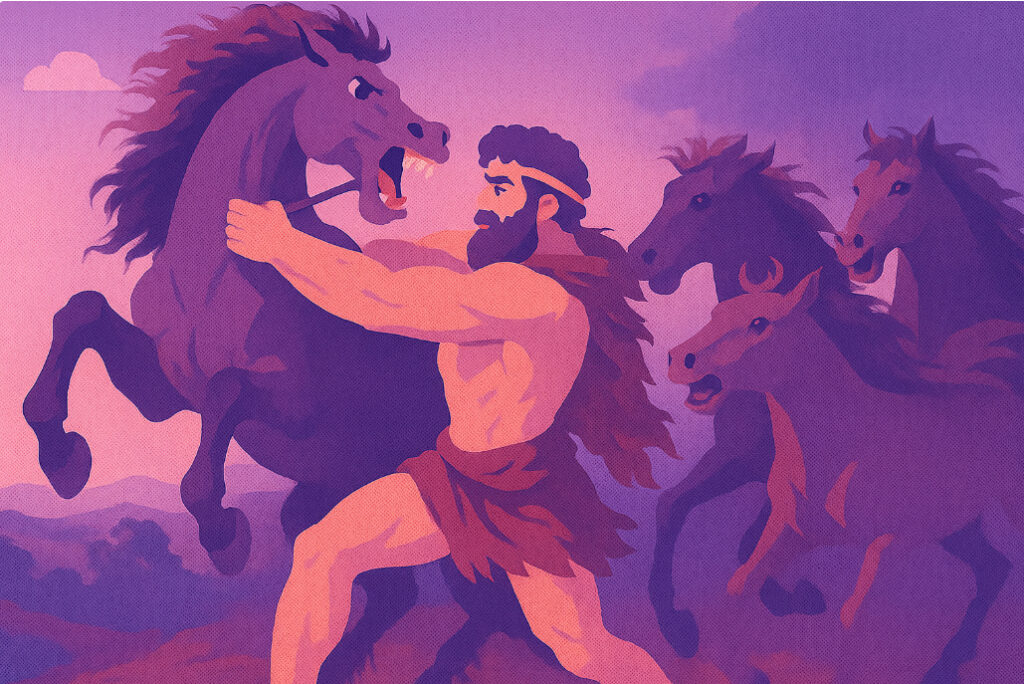
Hercules is sent by King Eurystheus to Thrace, to Diomedes, son of Ares (the god of war), to capture his mares. These were not mere animals, but monstrous creatures that fed on human flesh. Diomedes deliberately kept them in cruel conditions, using human vitality to feed their evil strength. Hercules manages to catch them but is attacked by the Bystonians (Diomedes’ people), and in the ensuing battle, he defeats them with the help of his friends. In the end, Hercules throws Diomedes himself to his food—his own mares.
On an initiatory level, this work symbolizes the struggle against conscious evil and violent selfishness, which sometimes dominate the mind and emotions of a human being.
Diomedes is the image of malicious, conscious, and organized selfishness, which uses the vital (etheric) energy of other beings to fuel its own dark forces. He embodies the dominant shadow of the personality, which, rather than transforming its desires, feeds on the suffering of others.
Horses represent groups of negative elementals—thought forms and emotion forms—created through destructive behavior, animalistic desires, and uncontrolled instincts. These subconscious forces have been fed by human vitality—’human flesh’—and become active, autonomous, and difficult to control.
The Bisons, Diomedes’ people, are other manifestations of these evil elementals, who revolt when the being tries to stop their source of energy. In contrast, Hercules’ friends are angelic forces, good elementals, pure intentions, and awakened consciousness, who come to the aid of the seeker of Truth.
This work has a powerful initiatory climax: Hercules offers Diomedes to his mares—meaning that evil destroys itself. Malicious selfishness, if left alone with its creations, consumes itself.
For the seeker of Truth, this work is a direct confrontation with personal and collective evil. It is the stage at which the human being discovers that in his subconscious there are groups of elementals that were not only created by him but have been constantly fed with his vitality—through hatred, revenge, envy, desires for power, humiliation of others, or even the destruction of his own being.
The seeker must realize that these mares cannot simply be stopped: they must be captured, transformed, and de-energized. It is not enough to fight the symptoms; evil must be taken to its source—conscious selfishness, represented by Diomedes.
Once defeated, Diomedes must be “sacrificed”—that is, his domineering personality, devoid of empathy and love, must be dissolved. Only then will the psychic forces that fed on it cease.
Through this work, the seeker learns a fundamental truth: we cannot destroy evil with evil, but we can transform the shadows of the subconscious if we bring the light of consciousness and the power of awakened will (Hercules).
This work also teaches the art of collaboration: without the help of friends (positive elementals, spiritual guides), victory is impossible. Thus, the seeker must learn to create pure, powerful, protective thought-forms and feeling-forms that will fight for him in the subconscious.
This is the work of healing inner evil, rebalancing psychic energies, mastering conflicts, and transforming shadows into light.